
Changing careers into technology is no longer unusual but it is still intimidating. For professionals coming from commerce, arts, science, management, or service industries, the idea of entering IT often brings one immediate fear: “I don’t have a technical background.” This fear, while understandable, is also outdated. Among all technology roles, Software Testing has consistently proven to be the most accessible and realistic entry point for non-IT professionals. Not because it is easy, but because it values thinking, verification, and judgment more than technical credentials.If you are looking for structured learning, enrolling in a best software training institute in Chennai can provide a guided pathway to master the necessary skills.
Software Testing Is About Trust, Not Just Technology
At its core, Software Testing exists because organizations cannot afford failure. When software controls payments, medical records, logistics, or customer data, even small errors can have serious consequences.
Software Testing answers questions such as:
- Can users complete their tasks without confusion?
- Does the system behave correctly when things go wrong?
- Are business rules implemented exactly as intended?
- Will this application hold up when real people use it in unpredictable ways?
This responsibility makes testing a thinking profession, not a mechanical one.
Why Non-IT Backgrounds Often Fit Testing Better Than Expected
Many non-IT professionals underestimate how relevant their experience already is.
- Someone who has worked in operations understands process flow.
- Someone from finance understands validation and risk.
- Someone from customer service understands real-world user behavior.
- Someone from education understands structured explanation and clarity.
- Software Testing depends on these exact abilities.
The role is less about knowing how systems are built and more about understanding how systems should behave.
Manual Testing: Where Almost Everyone Starts
Manual Software Testing is not a “lesser” role, it is a learning phase.
Manual testing teaches:
- How software projects actually function
- How requirements translate into features
- How defects impact users
- How teams communicate and collaborate
For non-IT professionals, this phase builds confidence and understanding far more effectively than jumping straight into tools or automation.
Understanding Software Without Writing Code
A major misconception is that understanding software requires coding. In testing, it does not.
Testers focus on:
- Inputs and outputs
- User flows
- Data movement
- Error handling
- System responses
Instead of asking “How is this built?”, testers ask: “What happens if this breaks?” This shift in thinking defines Software Testing.
Even for roles like automation test engineer, the thinking process is often more critical than coding at the start.
SDLC and STLC: Why Context Matters More Than Tools
Software Testing does not exist in isolation.
The Software Development Life Cycle (SDLC) explains how software moves from idea to deployment.
The Software Testing Life Cycle (STLC) explains how quality checks are planned and executed within that journey. For non-IT professionals, these cycles feel familiar because they resemble structured business workflows found in many industries.
Test Cases: Structured Thinking on Paper
Writing test cases is often misunderstood as documentation work. In reality, it is one of the strongest thinking exercises in Software Testing.
A test case forces you to:
- Understand the feature fully
- Identify assumptions
- Anticipate edge cases
- Define success clearly
Good testers do not write more test cases they write better ones.
Defects Are Communication, Not Complaints
Finding a defect is only useful if it is communicated clearly.
Effective defect reporting:
- Explains the issue without blame
- Provides steps anyone can follow
- Includes proof, not opinions
- Helps developers fix issues faster
This communication skill often comes more naturally to non-IT professionals than technical specialists.
How Much Technical Knowledge Is Actually Required?
At the entry level, technical depth is minimal.
What matters is understanding:
- How web and mobile apps behave
- What happens when data is submitted
- How systems respond to valid and invalid inputs
- Why certain failures are more serious than others
For example, a Software Developer may focus on building features, while a tester focuses on validating their behavior, making the roles complementary.
Databases and SQL: Validation, Not Programming
In Software Testing, databases are used to confirm the truth.
Testers use basic SQL to:
- Verify saved data
- Validate calculations
- Confirm updates and deletions
- Cross-check UI and backend values
This is logical verification, not development work.
Agile Testing: Where Testing Becomes Continuous
Modern projects follow Agile practices, which reshape testing work.
In Agile environments:
- Testing starts early
- Feedback cycles are short
- Documentation is lightweight
- Collaboration is constant
For non-IT professionals, Agile often feels intuitive because it mirrors iterative business processes.
Building Real Confidence Without Industry Experience
Confidence does not come from job titles, it comes from exposure. Non-IT professionals can build readiness by:
- Testing real websites and apps
- Writing test cases for common features
- Practicing defect explanations
- Reviewing real project scenarios
- Explaining concepts out loud
Some IT Companies in Chennai actively hire candidates with practical experience, making exposure even more valuable.
Entry-Level Roles: What Employers Actually Look For
Companies hiring junior testers do not expect mastery. They look for:
- Clear understanding of testing fundamentals
- Logical explanations
- Willingness to learn
- Clean documentation
- Consistent thinking
Degrees matter less than clarity.
Career Growth in Software Testing
Software Testing offers multiple long-term paths:
- Senior testing roles
- Automation testing
- Test leadership.
- Domain specialization
- Quality management
Non-IT professionals can also pursue AI engineer jobs later by combining testing experience with AI skills.
Common Struggles Non-IT Professionals Face
The hardest barriers are psychological, not technical:
- Fear of “not belonging”
- Comparing with developers
- Overestimating complexity
- Expecting quick results
Those who succeed treat Software Testing as a craft, not a shortcut.
Detailed Learning Roadmap for Beginners
Here’s a 12-week roadmap for non-IT professionals to become job-ready in software testing:
Week 1–2: Software Testing Fundamentals
- Understand the role of a tester
- Study manual vs automation testing
- Learn SDLC and STLC basics
Week 3–4: Manual Testing Techniques
- Learn functional and non-functional testing
- Black-box testing, smoke testing, sanity testing
- Practice test case and test scenario writing
Week 5–6: Defects and Bug Reporting
- Learn defect types, severity, and priority
- Practice writing clear bug reports
- Explore bug tracking tools like JIRA or Bugzilla
Week 7–8: Database Basics and SQL
- Understand database concepts
- Practice writing SELECT queries
- Validate backend data for test cases
Week 9: Web and Mobile Application Testing
- Learn client-server architecture
- Explore HTTP/HTTPS basics
- Test mobile apps and web apps manually
Week 10–11: Advanced Testing Concepts
- Introduction to automation tools (selenium training in chennai)
- Learn regression and performance testing basics
- Explore security testing concepts
Week 12: Hands-On Practice and Portfolio Building
- Test live websites or demo apps
- Create test case documents
- Document bugs and improvement suggestions
- Compile a portfolio to showcase your skills
Tip: Many institutes also include Live Projects, which help bridge the gap between theory and real-world practice.
Hands-On Practice Exercises for Beginners
Here are practical exercises to gain confidence:
- Test a Login Page: Check valid and invalid credentials, password reset, error messages.
- E-Commerce Website: Test product search, add-to-cart, checkout, payment workflows.
- Banking App: Test fund transfers, login/logout, OTP verification, account balance.
- Mobile App Testing: Install apps, test navigation, forms, notifications, performance under low network.
- Create Sample Test Cases: Document 5–10 test cases for each app, including steps, expected results, and test data.
- Report Bugs: Identify issues, document them in JIRA or Excel, and track their status.
Outcome: These exercises simulate real project experience and make you interview-ready.
Deep Dive: Types of Software Testing
Understanding different testing types helps you specialize later:
1. Functional Testing
Focuses on verifying software features against requirements:
- Unit Testing
- Integration Testing
- System Testing
- User Acceptance Testing (UAT)
2. Non-Functional Testing
Focuses on software performance, reliability, and usability:
- Performance Testing
- Load Testing
- Stress Testing
- Security Testing
- Usability Testing
3. Automation Testing
Uses tools to automate repetitive test cases:
- Selenium, QTP, TestComplete
- Continuous testing in Agile/DevOps pipelines
- Regression automation to save time
4. Performance Testing
Ensures software performs well under high load:
- Response time measurement
- Stress and load testing
- Benchmarking against standards
5. Security Testing
Protects applications from vulnerabilities:
- SQL injection testing
- Authentication and authorization checks
- Data privacy and encryption validation
Insight: Beginners start with functional/manual testing and can gradually move to specialized areas.
Building a Strong Portfolio as a Non-IT Professional
A portfolio demonstrates your skills to employers and makes you stand out:
- Document Projects: Include test cases, scenarios, and bug reports from practice apps.
- Showcase Tools Knowledge: Mention tools like JIRA, Bugzilla, TestRail.
- Highlight SQL Skills: Include queries and database validations performed.
- Include Automation Basics: Even small Selenium scripts are impressive.
- Add Learning Timeline: Demonstrate structured learning and commitment.
Tip: A well-structured portfolio can compensate for lack of formal IT experience.
Soft Skills and Mindset for Success in Software Testing
- Curiosity: Always ask, “What could go wrong here?”
- Patience: Testing can be repetitive, requiring attention to small details.
- Communication: Clear reporting of bugs and test results is crucial.
- Problem-Solving: Find solutions and suggest improvements proactively.
- Continuous Learning: Stay updated with tools, methodologies, and industry trends.
These soft skills often determine career growth as much as technical knowledge.
Industry Insights: Why Software Testing is in Demand
- Companies are adopting Agile and DevOps, requiring continuous testing.
- Mobile apps and web platforms dominate business operations, increasing QA demand.
- Automation and AI-driven testing are reducing repetitive work but increasing the need for skilled testers to design, analyze, and manage tests.
- Every industry from healthcare to fintech requires quality assurance to maintain reliability and user trust.
Insight: Non-IT professionals who master testing fundamentals and tools can tap into this growing market.
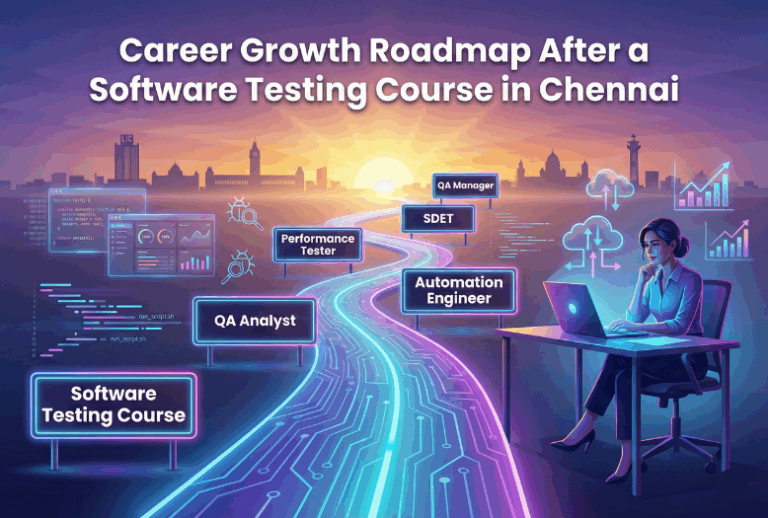
Suggested Career Path for Non-IT Professionals
- Entry-Level: Manual tester, QA trainee, Junior software tester
- Mid-Level: Senior tester, Automation tester, QA analyst
- Advanced Roles: Test lead, QA manager, Performance tester, Security tester, Business analyst, Product owner.
Tip: Some may later combine testing with AI in Software Development skills for more opportunities.
Salary Expectations and Growth
- Entry-Level: INR 3–5 LPA (India) / $40–50k (US)
- Mid-Level: INR 5–10 LPA / $60–80k
- Senior/Automation/Managerial Roles: INR 10–25 LPA / $90–120k
Observation: Automation and domain expertise significantly increase earning potential.
How Non-IT Professionals Can Stand Out
- Take online courses and certifications (e.g., ISTQB, Full stack developer course in Chennai, Mern stack)
- Build a hands-on portfolio with test cases and bug reports
- Volunteer to test open-source projects
- Participate in QA communities and forums
- Network with industry professionals on LinkedIn
Outcome: These actions increase visibility and improve job prospects.
Why Software Testing Will Not Disappear
Software may change, but quality cannot be ignored.
As systems become more complex:
- Testing becomes more critical
- Human judgment becomes more valuable
- User experience becomes non-negotiable
Software Testing evolves; it does not vanish.

Final Thoughts
Transitioning into Software Testing from a non-IT background is not about leaving your past behind, it’s about applying your experience in a new, impactful way. The profession values curiosity, logical thinking, and precision over purely technical skills. With consistent learning, hands-on practice, and a willingness to engage with real projects, non-IT professionals can build a rewarding career in Software Testing. It offers a stable entry into technology, opportunities for growth, and the chance to play a crucial role in delivering reliable and high-quality software.