
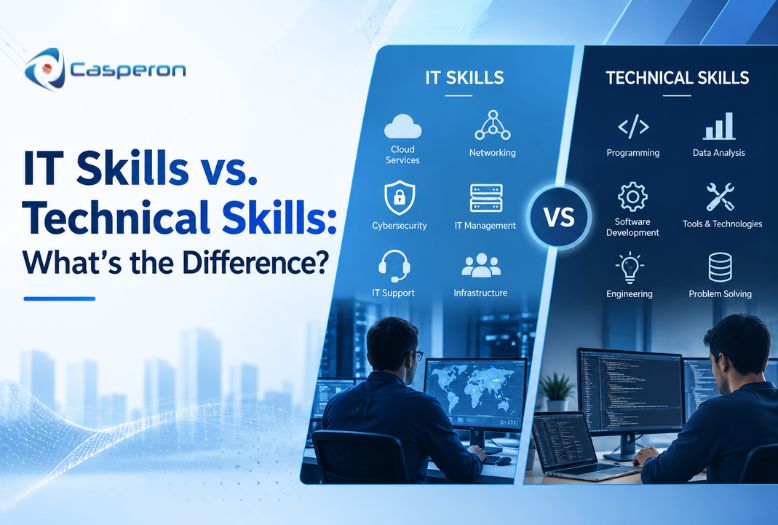

As technology continues to evolve, having the right IT Skills can make a major difference in building a successful career. However, many students and job seekers often use the terms IT skills and technical skills interchangeably. Although they are closely connected, they do not always mean exactly the same thing. Understanding the difference can help you choose the right learning path, improve your professional abilities, and prepare yourself for better career opportunities in the technology industry.
Technology is essential across industries, creating many opportunities in the IT field. As a result, employers value candidates who have the right skills to understand technology, solve problems, and work with modern tools. In this blog, we will explore the key differences between IT skills and technical skills, understand their importance, and look at the skills beginners can develop to build a successful career in the technology industry.
What Are IT Skills?
IT skills generally refer to the abilities required to work with computers, software, networks, databases, digital systems, and other information technology tools. These abilities can range from basic computer knowledge to advanced programming, cloud computing, cybersecurity, and database management.
In simple terms, these skills help professionals understand how technology works and how it can be used to solve business problems.
For example, an employee may need to know how to install software, manage files, troubleshoot a computer issue, work with databases, or understand a company’s network infrastructure. A software professional, on the other hand, may need programming and application development knowledge.
Some common areas include:
- Computer fundamentals
- Programming
- Database management
- Networking
- Cloud computing
- Cybersecurity
- Software testing
- Web development
- Mobile application development
- Data management
- DevOps
- Artificial intelligence
Therefore, the term can cover a very broad range of technology-related abilities.
What Are Technical Skills?
Technical skills are practical abilities that allow a person to perform a particular task or job. They are not limited to the technology industry. Professionals in engineering, healthcare, finance, manufacturing, design, marketing, and many other fields can have technical skills.
For example, a graphic designer may need to use professional design software. An accountant may need to work with accounting platforms and advanced spreadsheets. Similarly, a software developer needs programming languages and development frameworks.
In the technology sector, technical skills can include programming languages, testing tools, database technologies, development frameworks, cloud platforms, and automation tools.
Thus, technical skills are often more specific and job-focused, while IT-related abilities can cover a wider technology environment.
IT Skills vs. Technical Skills: Key Difference
Although there is some overlap between the two, the main difference is their scope.
| Area | IT Skills | Technical Skills |
| Meaning | Technology-related abilities used in IT environments | Practical abilities required to perform a specific task |
| Scope | Broad | Usually more specific |
| Industry | Mainly associated with technology and digital systems | Applicable across many industries |
| Examples | Networking, databases, cybersecurity | Java, Python, Selenium, SQL |
| Purpose | Manage, support, develop, or understand IT systems | Complete specific technical tasks |
| Career Use | IT support, developer, administrator, analyst | Developer, tester, engineer, designer, specialist |
For instance, understanding computer networks can be considered an IT-related ability. However, configuring a particular network device using a specific technology is a more specialized technical ability.
The two categories are not completely separate. In fact, many technology jobs require both.
Why Are These Skills Important in the IT Field?
The technology industry changes quickly. New programming languages, development frameworks, cloud platforms, automation tools, and artificial intelligence technologies appear regularly.
Employers look beyond academic qualifications. They also value candidates who can apply their knowledge to practical situations. For this reason, many learners choose Software training institutes in Chennai to gain hands-on experience and develop industry-relevant skills.
For example, a software developer may understand programming concepts but still struggle to build a real application without practical experience.
Similarly, a tester may know testing theory but need hands-on experience with automation tools to perform effectively. This is why practical learning plays an important role in building a successful technology career.
Furthermore, strong technical knowledge can help professionals:
- Solve workplace problems more efficiently
- Work confidently with modern software
- Adapt to new technologies
- Improve productivity
- Build real-world applications
- Qualify for specialized job roles
- Increase career growth opportunities
Important Skills to Learn for a Technology Career
There is no single skill that is perfect for everyone. Your learning path should depend on your career goal, interests, and current knowledge.
However, some areas have become especially useful for people entering the technology industry.
1. Programming
Programming is one of the foundations of software development. Languages such as Java, Python, JavaScript, and C# are used to create applications, websites, automation systems, and enterprise software.
Beginners should first understand programming fundamentals such as variables, conditions, loops, functions, data structures, and object-oriented programming.
2. Web Development
Web development is another popular career path. It involves creating websites and web applications that users access through browsers.
A learner can start with HTML, CSS, and JavaScript before moving toward frontend and backend technologies.
For students interested in modern web development, learning the Mern stack can provide exposure to MongoDB, Express.js, React, and Node.js. These technologies are widely used for building dynamic web applications.
3. Software Testing
Software testing ensures that applications work correctly and meet expected requirements. Testing professionals identify defects, verify functionality, and help improve software quality.
Manual testing provides a strong foundation, while automation testing can help professionals work with repetitive test cases more efficiently.
For example, Selenium training in Chennai can be useful for learners who want to understand browser automation and software testing practices.
4. Database Knowledge
Almost every modern application works with data. Therefore, understanding databases is valuable for developers, testers, analysts, and other technology professionals.
SQL is an important starting point. Learners can gradually move into database design, queries, joins, indexing, transactions, and database optimization.
5. Cloud Computing
Businesses increasingly use cloud platforms to host applications, store data, and manage computing resources.
Learning cloud fundamentals can help beginners understand concepts such as virtual machines, storage, databases, networking, security, and deployment.
6. Artificial Intelligence
Artificial intelligence is transforming the way companies build products and automate business processes. Developing ai skills can help professionals understand machine learning concepts, AI-powered applications, automation, and modern intelligent tools.
However, beginners do not necessarily need to start with advanced mathematics. They can begin with basic programming, data concepts, and an introduction to machine learning.
The Role of Full-Stack Development
A full-stack developer typically works with the user interface, server-side logic, databases, APIs, and application deployment.
For learners looking for structured practical education, a Full stack developer course in Chennai can provide a pathway to learn different technologies together rather than studying them separately.
A typical full-stack learning path may include:
- HTML and CSS
- JavaScript
- Frontend frameworks
- Backend programming
- Databases
- APIs
- Version control
- Testing
- Deployment
- Project development
IT Skills and Technical Skills for Beginners
Beginners often feel confused because there are so many technologies available. They may try to learn several programming languages at the same time and eventually lose focus.
Instead, it is better to follow a structured learning plan.
Start by identifying your career goal.
For example:
| Career Goal | Skills to Consider |
| Software Developer | Programming, databases, Git, frameworks |
| Full-Stack Developer | HTML, CSS, JavaScript, frontend and backend |
| Software Tester | Testing concepts, SQL, automation |
| Data Professional | Python, SQL, statistics, data tools |
| Cloud Professional | Linux, networking, cloud platforms |
| DevOps Professional | Linux, Git, CI/CD, containers, cloud |
| Mobile Developer | Programming, mobile frameworks, APIs |
Once you select a direction, focus on building depth instead of collecting certificates without practical knowledge.
IT Skills and Technical Skills in Software Development
Software development requires a combination of broad technology understanding and specialized technical knowledge.
A developer may need to understand how an application communicates with a database, how an API works, how code is stored using version control, and how applications are deployed.
At the same time, the developer needs specific programming and framework knowledge.
This combination makes practical education important. Quality software development courses should not focus only on theory. Learners should also receive opportunities to write code, build applications, debug problems, and understand development workflows.
Similarly, someone interested in becoming a Mern stack developer should not simply memorize framework concepts. Building complete applications is much more valuable because it demonstrates how different technologies work together.
Why Practical Learning Matters
One of the biggest differences between classroom knowledge and workplace knowledge is application.
Therefore, practical exposure should be an important part of learning.
Look for training that includes:
- Practical coding exercises
- Realistic assignments
- Debugging activities
- Application development
- Testing exercises
- Database projects
- Team-based activities
- Live Projects
- Interview preparation
- Resume guidance
This type of learning helps bridge the gap between education and employment.
Choose Casperon to Build Your IT Skills
Casperon offers practical, career-focused IT training to help learners build industry-relevant skills. With experienced trainers, hands-on sessions, and Live Projects, students can gain practical knowledge and prepare for real-world IT opportunities.
Whether you are a beginner or looking to upgrade your skills, choose Casperon to build your IT skills and take the next step toward your tech career.
If you are searching for the Best software training institute in Chennai, consider these factors before making a decision.
What Makes Casperon a Good Choice?
- Industry-relevant course content
- Experienced and supportive trainers
- Hands-on practical sessions
- Real-time project exposure
- Live Projects for practical experience
- Career-focused learning approach
- Interview preparation and guidance
- Support for developing job-ready technical skills
Most importantly, learning should go beyond completing a syllabus. At Casperon, the focus can be on helping learners understand concepts, practice their skills, work on projects, and prepare for the expectations of the IT industry.
Final Thoughts
Understanding the difference between IT skills and technical skills can help you choose the right career path. Whether you want to become a developer, tester, cloud professional, or data specialist, focus on learning the right skills, practicing regularly, and gaining practical experience.
Most importantly, keep learning and improving as technology changes. With the right training, hands-on practice, and dedication, you can build your confidence, develop job-ready skills, and move closer to a successful career in the IT industry.
Frequently Asked Questions
1. What is the main difference between IT and technical skills?
IT-related abilities generally cover a broad range of technology areas, including computers, networks, software, databases, and digital systems. Technical skills are usually more specific and may refer to a particular programming language, tool, platform, or task.
2. Which skills should a beginner learn first?
A beginner should start with basic computer knowledge and then select a career path. For software development, programming fundamentals, databases, web technologies, and problem-solving are good starting points. The exact learning path depends on the desired job role.
3. Are technical skills enough to get an IT job?
Technical knowledge is important, but employers may also look at communication, teamwork, problem-solving, adaptability, and practical experience. Building projects and preparing for interviews can therefore improve your chances of finding a suitable role.
4. Is full-stack development a good career option for beginners?
Full-stack development can be a useful career path for learners who are interested in building complete web applications. It involves frontend, backend, databases, APIs, and other development concepts. However, beginners should build strong fundamentals before moving into advanced frameworks.
5. How can I improve my technology skills?
You can improve by following a structured learning plan, practicing regularly, building projects, solving problems, learning relevant tools, and keeping your knowledge updated. Practical experience is especially valuable because it helps you understand how concepts are applied in real-world situations.