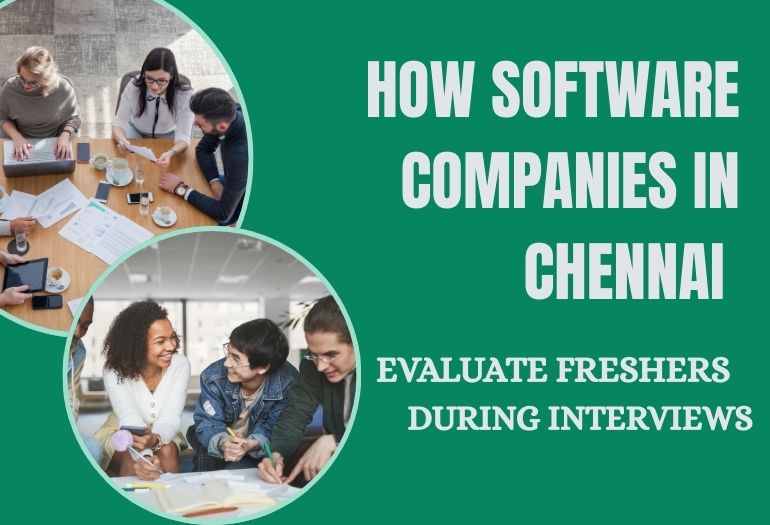

Chennai has emerged as one of India’s premier IT and software hubs. It hosts a wide range of companies, from large multinational corporations (MNCs) like TCS, Cognizant, Infosys, and Wipro to mid-sized IT service providers, product startups, and emerging technology firms. This diverse ecosystem provides opportunities across domains such as AI/ML, cloud computing, fintech, healthcare IT, e-commerce, and enterprise solutions. Every year, thousands of fresh graduates enter the workforce seeking employment in these software companies. With a growing demand for skilled professionals, companies have evolved structured and multi-layered evaluation processes to identify candidates capable of delivering real-world results.
The focus has shifted beyond academic knowledge. Today, software companies in Chennai assess practical skills, problem-solving ability, communication, teamwork, adaptability, and cultural fit. Understanding these evaluation methods is critical for freshers aiming to succeed in the competitive IT landscape of Chennai.
Current Trends in Fresher Hiring in Chennai
Software companies in Chennai are adapting their hiring strategies to align with industry trends and project requirements. Many freshers prepare for these evolving expectations by enrolling in the Best software training institute in Chennai, which helps them gain relevant skills and practical exposure. Some key trends include:
- Holistic Evaluation Process: Freshers are now evaluated across multiple dimensions, including pre-interview screening, technical rounds, behavioral assessment, role-specific evaluation, cultural fit, and adaptability to emerging technologies.
- Emphasis on Practical Skills: Recruiters prioritize candidates who can apply theoretical knowledge in real-world scenarios, including coding, debugging, and problem-solving.
- Digital Presence and Portfolios: GitHub contributions, personal projects, and LinkedIn activity are increasingly used as indicators of self-learning and genuine technical interest.
- Industry-Specific Focus: Companies in fintech, healthcare IT, e-commerce, and emerging tech sectors assess candidates based on domain-specific skills.
- Startup vs. MNC Hiring Differences: Startups emphasize flexibility, initiative, and multi-tasking, whereas MNCs value structured thinking, process adherence, and long-term cultural fit.
- Remote and Hybrid Interviews: With virtual hiring becoming common, online coding tests, video interviews, and scenario-based assessments have gained importance.
These trends highlight that software companies in Chennai are looking for well-rounded candidates who can quickly adapt to dynamic environments and contribute meaningfully to projects.
Pre-Interview Screening: The Initial Filter
Before stepping into an interview room, freshers undergo multiple pre-screening processes designed to filter candidates with a strong foundation and proactive attitude.
Resume and Portfolio Assessment
Recruiters examine resumes for relevant projects, internships, and skillsets. A single well-documented project that explains the problem, solution, and outcome often stands out more than multiple projects listed without context. Portfolios and GitHub repositories also carry weight, reflecting practical skills, consistency, and genuine interest in technology.
Key considerations:
- Relevant technical skills, certifications, and internships.
- Clear description of contributions and results for each project.
- Online portfolio, GitHub activity, and open-source contributions.
- Evidence of consistent learning and self-initiative, such as completing a Selenium training in Chennai course.
Online Pre-Placement Tests
Pre-placement tests have become a standard in Chennai’s IT recruitment. These may include:
- Aptitude: Logical reasoning, quantitative analysis, and verbal ability.
- Coding and Technical Tests: Programming exercises tailored to the role.
- Scenario-Based Questions: Problem-solving under constraints or situational judgment tests.
Performance in these tests is crucial, as many companies shortlist only the top performers for personal interviews.
Digital Footprint Check
A strong digital presence reflects continuous learning. Recruiters often check LinkedIn profiles, contributions to tech blogs, and participation in open-source projects. For example, freshers enrolled in a Full Stack Developer Course in Chennai can showcase completed projects on GitHub.
Technical Evaluation: More Than Just Knowledge
Once shortlisted, freshers face technical rounds designed to assess problem-solving ability, coding proficiency, and analytical thinking.
Core Technical Areas
- Programming Logic: Loops, recursion, conditions, and algorithmic thinking.
- Data Structures and Algorithms: Arrays, stacks, queues, hash maps, and sorting/searching techniques.
- System Optimization: Efficient memory and time usage, modular coding, scalability.
- Scenario-Based Problem Solving: Debugging issues, designing features under constraints, and troubleshooting errors.
Example: “A web application is experiencing slower load times during peak hours. How would you identify and fix the issue?” This tests practical reasoning, technical approach, and problem-solving mindset.
Project and Internship Assessment
Projects and internships demonstrate practical application of knowledge. Recruiters evaluate:
- Role and Contributions: Leadership of modules, key responsibilities.
- Challenges and Solutions: How technical or process issues were resolved.
- Learning and Reflection: Insights gained and improvements for future work.
Even short internships showcase exposure to workflows, deadlines, and teamwork, which is highly valued.
Behavioral Assessment: The Soft Skills Factor
Software companies in Chennai consider soft skills just as important as technical expertise. These attributes determine how well a candidate can collaborate, adapt, and thrive in a professional environment.
Communication Skills
Candidates must explain ideas clearly and concisely. Structured responses and logical sequencing are valued over rapid, unorganized answers. Interviewers often test communication during problem-solving discussions to see if candidates can articulate their thought process effectively.
Teamwork and Collaboration
Interaction during group exercises or discussions helps recruiters gauge teamwork ability in the IT field. Observing how candidates handle disagreements, contribute ideas, and respect diverse opinions provides insights into their potential to integrate into teams.
Adaptability and Emotional Intelligence
Recruiters may introduce unexpected changes during interviews or ask situational questions to assess adaptability. Emotional intelligence is measured by observing how candidates respond to feedback, maintain composure, and handle pressure.
Example: A candidate asked to switch from solving a coding problem to debugging an existing script is evaluated on adaptability, patience, and logical thinking under changing circumstances.
Project and Internship Evaluation: Depth Over Quantity
Projects and internships are vital indicators of a fresher’s ability to apply knowledge in real environments.
Evaluation Focus
- The role and contributions made by the candidate.
- Challenges encountered and how they were resolved.
- Understanding of design decisions and trade-offs.
- Ability to reflect on improvements and learning outcomes.
Why It Matters
Even small internships demonstrate exposure to project workflows, deadlines, and collaborative tasks. Recruiters are keen to understand whether a candidate can translate theoretical learning into practical applications.
Example: A fresher who contributed a module in a team project and can clearly explain the technical choices, challenges, and results will have an advantage over someone who only participated passively.
Role-Specific Evaluation
Different roles require tailored assessments. Chennai-based companies often design interviews according to the candidate’s intended job function.
Developer Roles:
- Coding and debugging proficiency.
- Modular thinking and logical approach.
- Error handling and optimization awareness.
Tester/QA Roles:
- Designing negative test cases.
- Attention to detail.
- Documentation and scenario-based testing.
UI/UX Roles:
- Understanding of user behavior.
- Design reasoning and layout efficiency.
- Accessibility and responsiveness awareness.
Cloud/DevOps Roles:
- Knowledge of automation tools.
- Infrastructure problem-solving.
- Cost optimization strategies.
Data/Analytics Roles:
- Ability to interpret data patterns.
- Identifying biases and sampling errors.
- Communicating insights clearly.
Industry-Specific Skills Assessment
Not all companies evaluate freshers in the same way. Sector-specific requirements are crucial:
- Fintech: Data security, transactional algorithms, and database optimization.
- Healthcare IT: Data compliance, patient data handling, and domain workflows.
- E-Commerce: User experience, high-traffic handling, and microservices knowledge.
- AI Roles: Understanding AI in Software Development helps candidates adapt quickly to emerging tech.
Understanding the industry helps candidates tailor preparation and highlight relevant skills.
Cognitive Ability and Logical Thinking Tests
Beyond technical skills, cognitive ability assessments are common:
- Pattern Recognition Tests: Analytical thinking evaluation.
- Problem-Solving Puzzles: Assess creative approaches.
- Time-Bound Reasoning Tasks: Test decision-making under pressure.
These identify candidates with fast learning ability and adaptability, essential for dynamic tech roles.
Soft Skill Simulations and Role-Play Exercises
Companies use practical simulations to evaluate interpersonal skills:
- Client Interaction Simulations: Present technical solutions to non-technical clients.
- Team Conflict Scenarios: Observe collaboration, negotiation, and problem-solving.
- Presentation Challenges: Assess clarity, confidence, and communication skills.
These exercises reflect real workplace performance, which can be a differentiator.
Technical Task Assignments During Interviews
On-the-spot tasks are increasingly common:
- Timed coding challenges.
- Debugging or optimizing existing code.
- Design tasks for UI/UX or front-end roles.
This evaluates hands-on skills, problem-solving speed, and practical application, beyond academic knowledge.
Peer Interaction and Group Problem-Solving
Collaboration is assessed through group exercises:
- Group coding exercises or collective problem-solving.
- Scenario discussions proposing multiple solutions.
- Peer feedback exercises to evaluate leadership and initiative.
These exercises measure teamwork, decision-making, and adaptability in collaborative settings.
Adaptability to Emerging Technologies
Recruiters test whether freshers can quickly learn and apply new tools:
- Cloud platforms: AWS, Azure, Google Cloud.
- Microservices, containerization, DevOps concepts.
- Full-stack frameworks like MERN Stack for web development roles.
Scenario-based questions often assess technical flexibility and learning mindset.
Understanding Company-Specific Work Culture
Cultural fit is increasingly important:
- Alignment with company values and vision.
- Comfort with agile, fast-paced environments.
- Openness to feedback and cross-team collaboration.
Even technically strong candidates may fail if they cannot integrate into company culture.
Cultural Fit and HR Rounds
Cultural alignment is subtle but critical. Companies assess whether candidates can integrate smoothly into the team and the company’s workflow.
HR evaluation includes:
- Motivation and career goals.
- Professional maturity and long-term vision.
- Handling challenging questions.
- Interpersonal skills and teamwork potential.
Recruiters often say that even technically strong candidates may be rejected if they fail the cultural fit assessment.
Continuous Learning and Self-Learning Potential
Companies value freshers who take initiative:
- Online courses and certifications.
- Contributions to open-source projects.
- Independent learning of frameworks or programming languages.
Self-learning reflects motivation and long-term growth potential.
Role of Mock Interviews and Peer Reviews
Some companies include internal mock interviews or peer evaluations:
- Simulated interviews to shortlist candidates.
- Peer evaluation of project contributions and coding quality.
- Feedback analyzed to assess readiness for professional work.
This ensures candidates are well-prepared, adaptable, and confident.
Post-Interview Assessment: Beyond Immediate Rounds
Evaluation often continues after the interview:
- Technical feedback may influence HR decisions.
- Performance in aptitude tests, scenario exercises, and role-plays is reviewed collectively.
- Strong candidates may be kept on waiting lists for future openings.
Understanding this helps freshers realize partial success still leaves a positive impression.
Startup vs. MNC Evaluation Differences
Chennai hosts both agile startups and structured MNCs, each with unique evaluation styles.
Startups
- Look for flexibility, fast learning, and initiative.
- Candidates are expected to handle multiple responsibilities and contribute immediately.
- Emphasis is on problem-solving agility and practical contributions rather than strict process adherence.
MNCs
- Focus on process compliance, structured thinking, and collaboration within global teams.
- Evaluate consistency, reliability, and long-term cultural fit.
- Candidates may face multiple technical rounds followed by HR assessments.
Understanding these differences allows freshers to tailor preparation based on the company type.
Common Mistakes Freshers Make During Evaluation
Freshers often fail to clear interviews not because of lack of knowledge, but due to errors in approach:
- Overlooking the importance of communication clarity.
- Ignoring practical application while focusing solely on theory.
- Not documenting projects properly or failing to explain contributions.
- Being unable to adapt to changes or unexpected problem statements.
- Failing to demonstrate teamwork and cultural alignment.
Avoiding these mistakes improves chances significantly.
Tips for Freshers to Succeed
- Build a strong portfolio with real contributions.
- Prepare for role-specific technical and scenario-based questions.
- Practice structured communication and problem articulation.
- Demonstrate adaptability, teamwork, and a learning mindset.
- Research company culture, products, and technologies.
- Be honest about knowledge gaps while showing eagerness to learn.
- Enroll in job-oriented courses to strengthen domain expertise.
Freshers who combine technical expertise, behavioral maturity, and proactive learning tend to outperform others.
Key Takeaways
To succeed in Chennai IT interviews, freshers should focus on:
- Industry-specific skills relevant to their target company.
- Hands-on coding, debugging, and problem-solving practice.
- Soft skills, including presentations, client interaction, and teamwork.
- Adaptability to emerging technologies and changing requirements.
- Alignment with company culture and values.
- Continuous self-learning through online courses, certifications, and open-source contributions.
Preparation across these dimensions ensures freshers present themselves as holistic candidates ready for real-world challenges.

Conclusion
Software companies in Chennai have evolved fresher evaluations into a comprehensive, multi-layered process. Candidates are assessed on technical knowledge, problem-solving, behavioral traits, project experience, role-specific skills, cultural fit, and adaptability.
Freshers who understand and prepare for these multiple layers from pre-screening to post-interview assessments can approach interviews confidently. In Chennai’s competitive IT ecosystem, success depends not just on technical knowledge, but on a balanced combination of skill, mindset, adaptability, and readiness for real-world challenges.