
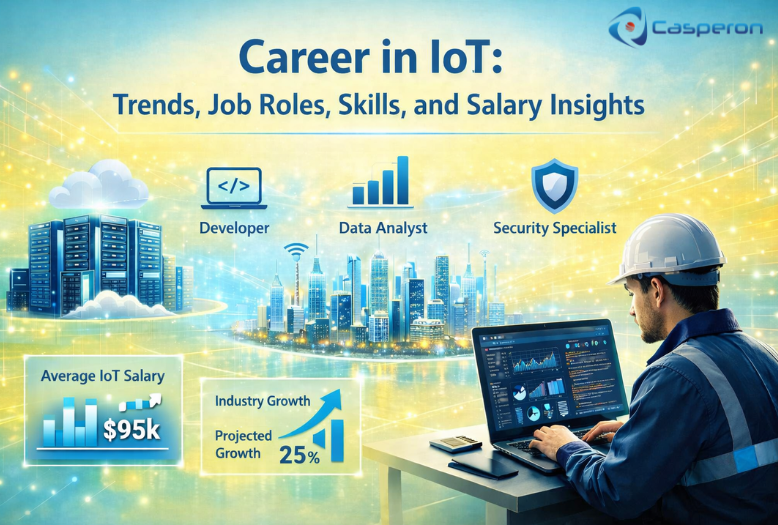

The Internet of Things (IoT) is transforming the digital landscape, connecting devices, machines, and systems like never before. From smart homes to industrial automation, IoT is driving innovation and creating numerous career opportunities across the IT Field. For tech enthusiasts, engineers, and IT professionals, a career in IoT promises high growth, lucrative salaries, and a chance to work on cutting-edge technology. In fact, this rapidly evolving field is transforming industries worldwide. In this blog, therefore, we explore the latest IoT trends, top job roles, essential skills, industry applications, certifications, tools, and future scope. Ultimately, this guide provides a complete roadmap to help you start a successful career in IoT.
What is IoT?
In essence, IoT is the network of interconnected devices capable of collecting, analyzing, and exchanging data .IoT devices can be as simple as a fitness tracker or as complex as industrial automation machinery used by global IT Companies.
Key components of IoT:
- Sensors and Devices
Collect real-world data such as temperature, motion, pressure, and health metrics. - Connectivity & Protocols
Wi-Fi, Bluetooth, Zigbee, LoRaWAN, 5G, and MQTT enable seamless communication between devices. - Data Processing
Edge computing processes data locally, while cloud platforms like AWS, Azure, and Google Cloud handle large-scale analytics. - Analytics & AI
Advanced analytics and AI in Software Development help convert raw IoT data into meaningful business insights. - Applications
Furthermore, IoT applications are widely used in smart homes, healthcare, industrial automation, agriculture, energy management, and transportation.
Example: For example, a smart factory uses sensors to monitor machine performance. AI algorithms predict maintenance needs, thereby reducing downtime and costs, making it a perfect combination of IoT.
Why a Career in IoT is in Demand
The IoT industry is expanding rapidly, especially across major software companies in chennai that are investing heavily in automation and intelligent systems.
- High Demand: As a result, IoT adoption is skyrocketing across healthcare, manufacturing, agriculture, transportation, and smart cities.
- Diverse Roles: Opportunities exist in software development, hardware design, data analytics, and security.
- Lucrative Salaries: IoT professionals earn competitive pay due to the scarcity of skilled talent.
- Innovative Work: You get to work on futuristic technologies like AIoT, edge computing, and smart infrastructure.
- Future-Proof Skills: IoT knowledge aligns with AI, robotics, and automation trends.
Latest IoT Trends Shaping Careers
Edge Computing
Enables real-time processing for applications such as autonomous vehicles and industrial automation.
AIoT (AI + IoT)
Additionally, AI-driven IoT systems support predictive maintenance, smart healthcare solutions, and intelligent urban planning.
Industrial IoT (IIoT)
Factories leverage IIoT for automation and efficiency, opening opportunities for engineers and system architects.
IoT Security
Consequently, as devices increase, security specialists play a vital role in protecting networks and data.
Smart Cities & Connected Vehicles
Accordingly, urban infrastructure, traffic systems, and smart grids rely heavily on IoT-enabled frameworks.
5G-Enabled IoT
Consequently, 5G networks improve speed, reliability, and scalability for large IoT deployments.
Healthcare IoT
Wearables and remote monitoring platforms are driving demand for professionals with strong ai skills and data expertise.
Industries with IoT Career Opportunities
IoT spans a wide range of industries, each offering unique roles:
Healthcare
- Roles: For instance, career opportunities in IoT include IoT healthcare developer, medical device engineer, and IoT data analyst.
- Applications: For example, IoT applications in healthcare include wearable health devices, remote patient monitoring, and smart hospitals.
Manufacturing & Industrial Automation
- Roles: For example, career opportunities in IoT include IoT engineer, industrial automation specialist, and IoT architect.
- Applications: Predictive maintenance, smart factories, robotic automation
Smart Homes & Consumer Electronics
- Roles: For example, career opportunities in IoT include embedded systems engineer, IoT app developer, and product designer.
- Applications: Smart appliances, connected lighting, home security
Agriculture & Environmental Tech
- Roles: IoT agricultural analyst, sensor engineer
- Applications: For example, IoT applications in agriculture include precision farming, smart irrigation, and climate monitoring.
Transportation & Logistics
- Roles: For example, career opportunities include fleet management analyst and connected vehicle engineer.
- Applications: Autonomous vehicles, logistics optimization, route tracking
Energy & Utilities
- Roles: Energy IoT engineer, smart grid developer
- Applications: For example, IoT applications include energy monitoring, predictive maintenance, and sustainable infrastructure.
Top Job Roles in IoT
Here’s a detailed overview of key IoT job roles:
| Job Role | Responsibilities | Required Skills |
| IoT Developer | Develop applications, integrate devices and cloud services | Python, Java, C, APIs |
| IoT Architect | Design end-to-end IoT systems, ensure scalability and security | System design, cloud platforms, networking |
| IoT Data Analyst / Data Scientist | Analyze IoT data for insights and predictive modeling | Python, R, SQL, ML |
| IoT Hardware Engineer | Design and build sensors, controllers, and devices | Electronics, PCB design, microcontrollers |
| IoT Security Specialist | Protect devices and networks from cyber threats | Cybersecurity, encryption, network protocols |
| Embedded Systems Engineer | Develop firmware and integrate hardware with software | C/C++, RTOS, hardware interfacing |
| IoT Consultant | Guide organizations in IoT adoption strategies | Technical expertise, business acumen, project management |
Many professionals transition into roles like Software Developer or specialize further as an automation test engineer within IoT-driven testing environments.
Real-World IoT Career Examples
- Smart Manufacturing: For instance, GE Digital uses IIoT sensors to monitor industrial machines. Consequently, engineers develop predictive algorithms to reduce downtime by up to 30%.
- Healthcare IoT: For example, Philips develops wearable devices that track heart rate and oxygen levels, while IoT developers integrate the data into cloud analytics platforms.
- Smart Cities: Cisco’s smart city projects in Barcelona use IoT traffic sensors to reduce congestion. IoT consultants design the overall infrastructure.
Therefore, these examples demonstrate that IoT careers are not hypothetical; they are active, high-impact roles shaping industries globally.
Essential Skills for a Career in IoT
Therefore, to succeed in a career in IoT, professionals need a mix of technical and analytical skills.
- Programming Languages: Python, C, C++, Java, JavaScript
- Networking Protocols: MQTT, CoAP, HTTP, Zigbee, LoRaWAN, Bluetooth
- Cloud Platforms: AWS IoT, Microsoft Azure IoT, Google Cloud IoT
- Data Analytics & Machine Learning: Processing IoT-generated data for insights
- Embedded Systems & Electronics: Microcontrollers, sensors, circuit design
- Cybersecurity: Protecting IoT devices and networks from attacks
- Soft Skills: Problem-solving, critical thinking, communication, project management
Those aiming for advanced roles often upskill through job oriented courses aligned with industry needs.
Salary Insights in IoT
IoT offers competitive salaries due to high demand and specialized skills:
| Job Role | India | USA | Europe |
| IoT Developer | ₹4–10 LPA | $85,000–$120,000 | €60,000–€90,000 |
| IoT Architect | ₹12–25 LPA | $120,000–$160,000 | €90,000–€130,000 |
| IoT Data Analyst | ₹5–12 LPA | $80,000–$110,000 | €55,000–€85,000 |
| IoT Hardware Engineer | ₹6–15 LPA | $90,000–$130,000 | €60,000–€95,000 |
| IoT Security Specialist | ₹8–18 LPA | $110,000–$150,000 | €70,000–€110,000 |
| Embedded Systems Engineer | ₹5–12 LPA | $80,000–$120,000 | €55,000–€85,000 |
Tools & Platforms for IoT Professionals
In addition, IoT professionals rely on various tools and platforms to design, develop, and manage IoT solutions:
- IoT Hardware Platforms: Arduino, Raspberry Pi, ESP32
- Cloud Platforms: AWS IoT Core, Microsoft Azure IoT, Google Cloud IoT
- Networking & Protocols Tools: MQTT brokers, Zigbee, LoRaWAN modules
- Data Analytics Tools: Python, R, Power BI, Tableau
- Security Tools: Encryption libraries, vulnerability scanners, penetration testing software
Hands-on exposure through Live Projects significantly improves real-world readiness.
Certifications to Boost Your IoT Career
Certifications improve credibility and open high-paying roles:
- AWS Certified IoT Developer – Focus on cloud-based IoT solutions
- Microsoft Azure IoT Developer – Azure cloud integration for IoT
- Cisco IoT Fundamentals – Networking and device integration
- Google Cloud IoT Core Certification – IoT device connectivity and cloud deployment
- Certified Internet of Things Professional (CIoTP) – End-to-end IoT expertise
Many learners begin their journey at the Best software training institute in Chennai, which often integrates cloud and IoT certifications into structured programs.
Learning Roadmap for a Career in IoT
Therefore, here’s a structured approach to building a successful career in IoT:
- Educational Foundation: Degree in Electronics, Computer Science, IT, or Mechatronics
- Understand IoT Basics: Sensors, microcontrollers, IoT protocols, and cloud integration
- Hands-On Projects: Arduino, Raspberry Pi, ESP32 projects for practical experience
- Specialization: Choose a focus development, hardware, analytics, or security
- Certifications: AWS, Azure, Cisco, or Google Cloud IoT certifications
- Internships & Real-World Projects: Gain practical industry experience
- Networking: Join IoT communities, attend webinars, workshops, and conferences
- Continuous Learning: Keep updated with trends like AIoT, edge computing, and smart cities
Some learners complement IoT skills with courses like Full stack developer course in Chennai or frameworks such as Mern stack to strengthen application development expertise.
Hands-On Projects to Boost IoT Careers
- Smart Home Automation: For example, you can automate lights, fans, and appliances using Arduino and Raspberry Pi.
- IoT Health Tracker: Build a wearable device to monitor heart rate and send data to a mobile app.
- Smart Irrigation System: For example, soil moisture sensors and a cloud platform can be used to automate watering in agriculture.
- Fleet Tracking System: GPS-enabled vehicle monitoring system integrated with a cloud dashboard.
- Energy Monitoring: For example, an IoT-enabled smart meter can track electricity consumption and optimize usage.
These projects also help professionals understand testing workflows relevant to software testing roles in IoT environments.
Emerging Domains in IoT
The future of IoT careers lies in emerging technologies:
- AIoT Solutions: Predictive analytics, intelligent automation
- Autonomous Vehicles: Connected cars, traffic management systems
- Smart Healthcare: Wearables, remote patient monitoring, telemedicine
- Industrial Automation & Robotics: IIoT-enabled smart factories
- Smart Cities & Energy Management: Smart grids, renewable energy optimization
These areas are creating demand for hybrid roles, including ai engineer jobs that combine intelligence with connected systems.
Future Scope of IoT Careers
- AI-Integrated IoT Systems: Predictive analytics for industries, smart devices
- Autonomous Vehicles: Connected, intelligent transportation systems
- Healthcare IoT Expansion: Remote patient iot monitoring, AI diagnostics
- Industrial Automation: Smart factories, robotics, energy efficiency
- Smart Cities & Sustainability: Urban IoT infrastructure, energy optimization
Key Insight: Professionals with AI + IoT + Security expertise will lead the next decade of technology innovation.

Conclusion
Overall, IoT continues to push technology beyond screens and software, bringing intelligence into everyday systems that power industries and cities. As a result, as businesses shift toward automation, real-time data, and connected infrastructure, IoT professionals are becoming key drivers of this transformation. The field rewards those who combine technical knowledge with curiosity, problem-solving, and hands-on experience. With endless opportunities to learn, build, and innovate, a career in IoT offers more than growth it offers relevance in a world that’s becoming smarter every day. Starting now means growing alongside technology, not chasing it later.