
Choosing the right IoT Course is one of the most important decisions if you want to build a successful career in today’s technology-driven world. The Internet of Things (IoT) is transforming industries by connecting smart devices, automating processes, and enabling data-driven decision-making. As businesses across healthcare, manufacturing, agriculture, logistics, retail, and smart cities continue to adopt IoT solutions, the demand for skilled professionals is increasing rapidly. Therefore, enrolling in a well-structured IoT course is essential for building practical skills and staying competitive in the evolving IT industry.
You will learn how to evaluate course curriculum, trainer expertise, practical learning opportunities, certifications, placement assistance, and industry relevance before making a decision. Moreover, if you are looking for the best software training institute in Chennai, understanding these factors will help you identify a training provider that offers comprehensive learning, experienced mentors, and strong career support. By the end of this guide, you will have a clear understanding of how to choose an IoT course that aligns with your career aspirations and prepares you for exciting opportunities in one of the fastest-growing technology domains.
What is IoT and Why is it Important?
The Internet of Things, commonly known as IoT, refers to a network of physical devices connected through the internet. These devices collect, share, and analyze data to improve efficiency and automate processes. From smart homes and wearable devices to industrial automation and healthcare systems, IoT has become an essential part of modern life.
As businesses continue to invest in connected technologies, the demand for IoT professionals is increasing. Consequently, enrolling in the right IoT Course can help you gain the skills required to work on innovative projects across multiple industries.
Today, organizations are using IoT for:
- Smart home automation
- Healthcare monitoring
- Manufacturing automation
- Agriculture technology
- Logistics and transportation
- Energy management
- Retail analytics
Because of these growing applications, IoT professionals are among the most sought-after technology experts.
Why Should You Learn IoT?
Learning IoT offers numerous benefits for both beginners and experienced professionals. Unlike many technologies that focus on only one area, IoT combines programming, networking, electronics, cloud computing, artificial intelligence, and cybersecurity. Therefore, mastering IoT gives you knowledge across multiple technical domains.
A well-designed IoT Course helps learners understand how devices communicate, process data, and deliver intelligent solutions. In addition, it prepares students for real-world development environments where practical problem-solving skills are highly valued.
Some major advantages include:
- High demand across industries
- Attractive salary packages
- Global career opportunities
- Practical technical skills
- Opportunity to work on innovative projects
- Continuous learning and career growth
Furthermore, many organizations are looking for professionals who can develop smart solutions that improve business efficiency and customer experience.
Identify Your Career Goals Before Choosing a Course
Before enrolling in any training program, it is important to understand your career objectives. Every learner has different goals, and choosing a course that matches those goals will help maximize your learning experience.
Ask yourself these questions:
- Do you want to become an IoT developer?
- Are you interested in embedded systems?
- Do you enjoy programming?
- Do you want to work with cloud platforms?
- Are you planning to enter industrial automation?
Once you identify your interests, selecting the right IoT Course becomes much easier.
For example, someone interested in application development may also consider a Full stack developer course in Chennai to strengthen both front-end and back-end development skills alongside IoT technologies.
Check the Course Curriculum Carefully
One of the biggest mistakes students make is selecting a course based only on advertisements or course fees. Instead, carefully review the syllabus before enrolling.
A professional IoT curriculum should include:
Programming Languages
- Python
- C
- C++
- Java
Networking Concepts
- TCP/IP
- MQTT
- HTTP
- Bluetooth
- Zigbee
- Wi-Fi
Embedded Systems
The course should provide hands-on exposure to essential IoT hardware, including Arduino, ESP32, Raspberry Pi, and various sensor components used in smart device development.
Cloud Integration
Modern IoT applications rely heavily on cloud platforms for data storage, monitoring, and analytics.
Security
Cybersecurity is a critical aspect of IoT because connected devices are vulnerable to cyber threats.
Additionally, many learners also explore Software development courses to improve their programming and software engineering knowledge.
Practical Learning is More Important Than Theory
Many students believe completing theoretical lessons is enough to get hired. However, employers prefer candidates with practical experience.
A good IoT Course should provide opportunities to work on:
- Real-world projects
- Hardware implementation
- Sensor integration
- Cloud deployment
- Device communication
- Industry case studies
Hands-on experience improves confidence and prepares students for technical interviews.
Furthermore, working on IoT device monitoring projects helps learners understand how connected devices send and receive data in real-time. These practical applications closely resemble actual business environments.
Learn from Experienced Trainers
An experienced trainer can make a significant difference in your learning journey. Trainers who have worked on live industry projects can explain complex topics in simple language and share practical insights that textbooks often miss.
Before joining any institute, check:
- Trainer experience
- Industry certifications
- Student reviews
- Practical exposure
- Teaching methodology
Similarly, among various best software training institutes in Chennai, choose one that focuses on interactive sessions, mentorship, and project-based learning instead of only classroom lectures.
Experienced mentors also guide students on interview preparation, resume building, and current industry expectations, making them more confident when applying for jobs.
Stay Updated with Industry Trends
Technology evolves quickly, and IoT is no exception. Therefore, continuous learning is essential even after completing your training. Employers value candidates who keep their skills current and adapt to new technologies.
Some of the trending technologies to learn alongside IoT include Artificial Intelligence, Edge Computing, Cloud Computing, 5G, Cybersecurity, and Data Analytics. Learning these complementary technologies can significantly improve your career prospects and help you work on more advanced IoT solutions.
In the next part, we’ll cover certifications, live projects, placement support, career opportunities, salary expectations, common mistakes to avoid, conclusion, and 5 SEO-friendly FAQs.
Choose a Course That Offers Live Projects
Learning theory is important, but practical experience is what makes you job-ready. Therefore, before enrolling in any training program, check whether it includes Live Projects. Working on real-time applications helps you understand how IoT solutions are designed, developed, tested, and deployed in industries.
For example, you may build a smart home automation system, weather monitoring application, or industrial sensor network. These projects improve your problem-solving skills and give you confidence to work in a professional environment.
Additionally, live projects help you:
- Understand real business requirements.
- Improve coding and debugging skills.
- Learn teamwork and project management.
- Build a strong portfolio for interviews.
- Gain confidence while solving practical challenges.
Moreover, employers often prefer candidates who can demonstrate hands-on experience instead of only theoretical knowledge.
Check Placement Support and Career Guidance
Placement assistance is another important factor when selecting an IoT Course. A good training institute should not stop at teaching technical concepts. Instead, it should also prepare students for the recruitment process.
Look for institutes that provide:
- Resume preparation
- Mock interviews
- Aptitude training
- Technical interview sessions
- Communication skill development
- Placement drives
Furthermore, career guidance sessions help students understand industry expectations and choose the right career path based on their interests and strengths.
Industry Certifications Add Value
Certifications validate your technical skills and make your resume more attractive. Although skills are the most important factor, recognized certifications show employers that you have completed structured training.
Before choosing a course, check whether it provides:
- Course completion certificate
- Project certification
- Internship certificate (if available)
- Industry-recognized credentials
As a result, your profile becomes more competitive in today’s job market.
Learn Related Technologies Along with IoT
IoT is not an isolated technology. Instead, it works together with several other domains. Therefore, learning complementary technologies can significantly improve your career opportunities.
One of the most important areas today is AI in Software Development. Artificial Intelligence enables IoT devices to make intelligent decisions by analyzing collected data. Smart healthcare systems, autonomous vehicles, predictive maintenance, and smart cities all depend on the combination of AI and IoT.
Similarly, if you are interested in web applications that communicate with IoT devices, learning Modern Stack job oriented courses can be highly beneficial. MERN Stack helps developers build modern dashboards and web applications for monitoring IoT data in real time.
Likewise, students interested in quality assurance can consider Selenium training in Chennai to understand automation testing techniques for web applications connected to IoT platforms.
Importance of IoT Infrastructure
To build successful IoT applications, learners must understand the complete IoT ecosystem instead of focusing only on programming.A quality course should explain important concepts such as:
IoT Gateway
An IoT gateway acts as the communication bridge between smart devices and cloud platforms. It collects data from multiple sensors, processes information, and securely transfers it to cloud services.
IoT Device Management
Modern organizations deploy thousands of connected devices. Therefore, IoT device management is essential for monitoring, configuring, updating, and maintaining these devices remotely.
IoT Monitoring
Another important concept is IoT monitoring (commonly referred to as IoT monitoring). It helps organizations track the performance, health, and connectivity of smart devices in real time. Effective monitoring reduces downtime and improves operational efficiency.
Understanding these concepts prepares students for real-world industrial applications.
Career Opportunities After Completing an IoT Course
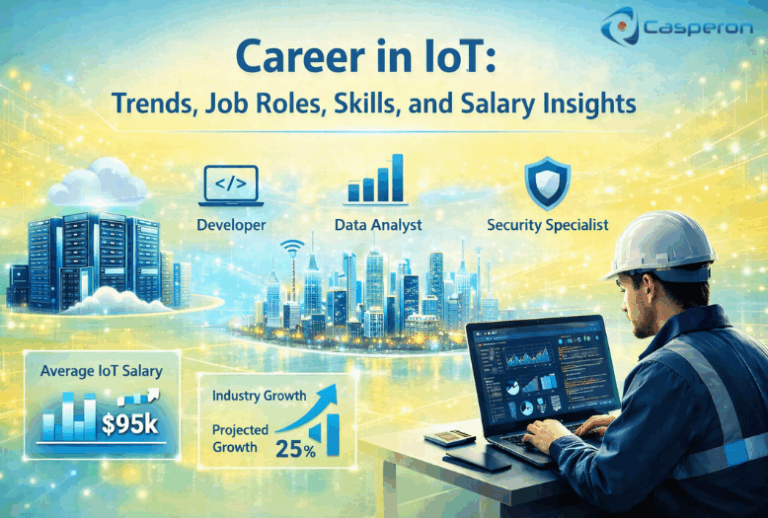
The demand for IoT professionals is increasing across healthcare, manufacturing, retail, agriculture, transportation, logistics, and smart city projects. Consequently, completing the right IoT Course can open the door to several rewarding career opportunities.
Popular job roles include:
- IoT Developer
- Embedded Systems Engineer
- Cloud Engineer
- IoT Solution Architect
- Firmware Developer
- Network Engineer
- Security Engineer
- Data Analyst
- Automation Engineer
- Research Engineer
As technology continues to evolve, professionals with IoT expertise are expected to remain in high demand for many years.
IoT Skills You Should Develop
If you carefully evaluate your options and choose a high-quality training program, you will be well-prepared to enter one of the most exciting and rapidly growing fields in technology.Besides technical knowledge, successful IoT professionals possess a combination of soft skills and problem-solving abilities.
Important technical skills include:
- Programming fundamentals
- Networking concepts
- Cloud computing
- Database management
- Embedded systems
- Sensor integration
- API development
- Cybersecurity basics
At the same time, develop soft skills such as:
- Communication
- Team collaboration
- Critical thinking
- Time management
- Creativity
- Analytical thinking
These skills help professionals succeed in both technical interviews and workplace environments.
Common Mistakes to Avoid While Choosing an IoT Course
Many students select a course without proper research. However, avoiding a few common mistakes can save both time and money.
Some mistakes include:
- Choosing the cheapest course without checking quality.
- Ignoring the practical training component.
- Not verifying trainer experience.
- Selecting outdated course content.
- Overlooking placement assistance.
- Ignoring student reviews.
- Not checking certification value.
- Focusing only on theory.
Therefore, always compare multiple institutes before making your final decision.A good course should prepare you not only to pass interviews but also to perform confidently in real industry projects.
Conclusion
Technology is transforming every industry, and the Internet of Things is playing a major role in this digital revolution. From smart homes and connected healthcare systems to industrial automation and intelligent transportation, IoT solutions are creating new opportunities for businesses and professionals alike. Therefore, investing your time in learning IoT can be one of the best decisions for your future.
Choosing the right IoT Course is not simply about completing a certification. Instead, it is about gaining practical skills, understanding real-world applications, and preparing yourself for a successful career in the IT industry. A well-designed course should include an updated curriculum, experienced trainers, hands-on projects, placement support, and exposure to the latest industry technologies.
FAQ’s
1. Who can join an IoT course?
An IoT course is suitable for engineering students, diploma holders, IT graduates, working professionals, electronics enthusiasts, and anyone interested in learning smart technologies. Even beginners with basic computer knowledge can start learning IoT.
2. What skills will I learn in an IoT course?
Most IoT programs cover programming languages, embedded systems, sensors, networking, cloud computing, device communication, data analysis, IoT security, and practical project development. Many institutes also include hands-on training using popular development boards and cloud platforms.
3. Is IoT a good career choice in 2026 and beyond?
Yes. IoT continues to be one of the fastest-growing technology domains. Industries such as healthcare, manufacturing, agriculture, automotive, logistics, and smart city development are actively hiring skilled IoT professionals, making it a promising long-term career option.
4. How do I choose the best IoT training institute?
Look for an institute that offers an updated curriculum, experienced trainers, practical lab sessions, live projects, placement assistance, industry-recognized certification, and positive student reviews. Comparing these factors will help you make an informed decision.
5. What are the career opportunities after completing an IoT course?
After completing an IoT course, you can apply for roles such as IoT Developer, Embedded Systems Engineer, IoT Solution Architect, Firmware Engineer, Cloud Engineer, Network Engineer, Automation Engineer, Security Engineer, Research Engineer, and Technical Consultant. With experience, you can also move into leadership or specialized technical roles.